After years of running PADI courses in Okinawa’s waters, one pattern shows up again and again. The divers who stay safest aren’t always the most experienced. They’re the most consistent.
They do the same checks, ask the same questions, and hold to the same limits every single time. This guide covers what that looks like in practice: gear checks, depth limits, in-water behaviour, and how to vet a dive operator before you ever enter the water.
Is Scuba Diving Safe?
Scuba diving is statistically safe, but safety is never automatic. The DAN Annual Diving Report, published through the U.S. National Library of Medicine, shows the same pattern year after year: the majority of diving incidents are linked to preventable factors. Skipping pre-dive checks, exceeding certification limits, diving while fatigued, or ignoring early warning signs underwater.
The real question isn’t whether diving is safe in the abstract. It’s what divers actually do to make their dives safe, and whether the people guiding them hold themselves to the same standard.
What Should Divers Do for Their Own Safety Before Every Dive
Most incidents are preventable, and most prevention happens before you even put on your fins. Pre-dive preparation splits into three areas: your physical readiness, your dive plan, and your gear.
Are You Physically Ready to Dive Today?
Before every dive, ask yourself honestly: Are you well-rested? Have you consumed alcohol in the last 12 hours? Are you adequately hydrated? Do you have any symptoms, a cold, ear congestion, or unexpected fatigue?
If the answer to any of these raises a flag, the dive waits. If you have any pre-existing health conditions, completing a Diving Medical Statement and getting cleared by a physician is non-negotiable.
First-time students often underreport ear issues on dive day, hoping they’ll clear on descent. They rarely do, and the result is a painful, aborted dive at best.
What Does Proper Dive Planning Involve?
Research the site’s conditions before every dive: expected visibility, current direction and strength, tidal windows, and known hazards like boat traffic or surge zones. Know the location of the nearest hyperbaric chamber. Any competent operator will cover this in the briefing.
Agree on a clear dive plan with your buddy: maximum depth, turn pressure, and emergency signals. “We’ll turn around when the air gets low” isn’t a plan. A specific pressure and a specific signal is.
How to Verify Your Gear Is Safe Before Entry
Run a full buddy check before every dive using the BWRAF framework:
- BCD inflates and deflates correctly
- Weights positioned and release mechanism accessible
- Releases and straps secure
- Air on and pressure adequate
- Final check: mask, fins, computer, signaling devices
If gear doesn’t feel right (a stiff regulator, a BCD that won’t hold air, a computer with a low battery warning), speak up before entering the water. A trustworthy operator will swap it without question. Before accepting any rental equipment, running through a pre-dive regulator and first stage check will tell you immediately whether the gear is dive-ready.
The Golden Rules for Safe Diving in the Water

Once you’re underwater, these are non-negotiables:
Never dive alone. Most underwater emergencies are survivable with a second diver present. Stay within visual range of your buddy throughout the dive.
Control your buoyancy. Poor buoyancy is one of the leading contributors to underwater accidents. It causes uncontrolled ascents, reef collisions, and air consumption spikes.
Ascend slowly and complete a safety stop. Five meters for three minutes. Never skip this after dives deeper than 10 meters.
Follow the one-third air rule. One-third going out, one-third returning, one-third in reserve. Never push past your turnaround pressure.
Stay within your certification limits. Your card reflects the skills and emergency procedures you’ve actually practiced. Diving beyond it means diving outside them.
Equalize early and often. Start before you descend, and continue every meter or two on the way down. Never wait until you feel pressure.
How Deep Is It Safer to Dive?
Safe diving depth is tied to your certification level, experience, conditions, and equipment. Not just a single number.
The recreational diving limit is 40 meters and should only be approached by Advanced-certified divers with appropriate experience. PADI Open Water certification carries a limit of 18 meters when diving supervised, with an absolute limit of 20 meters.
Deeper dives introduce two key risks: nitrogen narcosis (impaired judgment starting around 30 meters) and decompression sickness (caused by ascending too quickly or exceeding no-decompression limits).
Most recreational dives take place between 12–25 meters, where conditions, marine life, and visibility are typically at their best anyway. The Advanced Open Water Diver course is the pathway to safely extending your depth range, not impatience.
Scuba Diving Safety Equipment Every Diver Should Carry
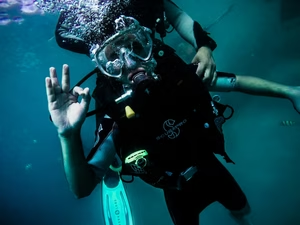
Standard scuba kit (BCD, regulator, wetsuit, mask, fins, dive computer) is the baseline. These safety-specific items are commonly skipped:
Surface Marker Buoy (SMB). The most commonly missed piece of safety kit for newer divers. An SMB signals your position to boats and surface support during your ascent. Deploy it on every open water dive. Non-negotiable.
Dive computer. Tracks your nitrogen loading in real time and alerts you when you’re approaching no-decompression limits. Dive tables alone can’t account for multi-level profiles.
Dive knife or line cutter. Entanglement in fishing line, nets, or kelp is a real hazard. A small, accessible cutting tool resolves the situation in seconds.
Audible and visual signaling devices. A whistle on your BCD inflator, a signal mirror, or a tank banger helps you get attention when your buddy drifts out of visual range.
Most divers assume the operator supplies an SMB. Always confirm before you book. If an operator can’t supply a functioning SMB or lacks basic signaling devices, that’s a concern worth raising.
How to Evaluate a Dive Operator’s Safety Standards Before You Book
Checking safety credentials, insurance, and emergency procedures before you commit to an operator is what experienced divers treat as standard.
Red Flags to Watch For
- Staff who can’t clearly explain the emergency action plan
- No oxygen kit visible or accessible on the boat
- Rushed, vague, or skipped dive briefings
- Reluctance to discuss insurance or instructor certifications
- Large group sizes without adequate staff-to-diver ratios
- Rental gear that looks worn, poorly maintained, or mismatched
Green Flags That Signal a Safe Operator
- Active PADI certification and current instructor credentials available on request
- Clear pre-dive briefing covering site conditions, emergency procedures, and hand signals
- Oxygen and first aid kit on board, with staff trained to use them
- Reasonable group sizes with attentive divemaster guidance
- Reviews that specifically mention safety culture
In a market where English-language operations aren’t always the norm, an operator who communicates safety protocols clearly in English offers real added value for international divers. These are the standards we hold ourselves to on every dive.
What Divers Should Do After a Dive and Between Dives
Surface intervals matter. Your dive computer calculates your minimum surface interval automatically. Follow it. Don’t estimate.
No-fly rules are firm. DAN-recommended guidelines: wait at least 12 hours after a single no-decompression dive, 18 hours after multiple dives in one day, and 24 hours after repetitive diving over multiple days.
Hydrate consistently. Dehydration is a known risk factor for decompression sickness. Drink water between dives, not alcohol.
Know the symptoms of DCS. Joint pain, unusual fatigue, skin mottling, tingling or numbness, dizziness, or any neurological changes after a dive should be treated as an emergency. Seek hyperbaric treatment immediately.
Why Proper Certification Is the Foundation to Safe Diving
Every safety behaviour in this guide (buoyancy control, air management, buddy systems, emergency procedures) is taught through proper certification. If you’ve never dived before, the PADI Discover Scuba Diving experience is the safest first step. The Open Water Diver course is where the real foundation starts.
Our instruction pipeline runs from Open Water through Advanced, Rescue Diver, and Divemaster, entirely in Okinawa’s waters and entirely in English.
Diver Safety FAQs
What should divers do for their own safety before entering the water?
Complete a physical readiness check, finalize a dive plan with your buddy, and run a full BWRAF equipment check. Confirm air supply, BCD function, weights, and signaling devices. If you have any health conditions, carry a current dive medical clearance. In Okinawa, where conditions can shift with tidal movement and seasonal currents, a full site briefing from your operator is part of preparation, not an optional extra.
How deep is it safe to dive without advanced training?
PADI Open Water certification limits recreational divers to 18 meters under supervision and 20 meters as an absolute maximum. The recreational ceiling for advanced divers is 40 meters. Exceeding entry-level limits without proper training exposes divers to nitrogen narcosis and decompression risks their skills aren’t yet designed to manage.
What are the biggest scuba diving safety mistakes divers make?
Skipping or rushing the buddy check, ascending too quickly and skipping the safety stop, ignoring air supply until it’s critically low, diving beyond certification limits, and choosing an operator without checking their safety credentials, emergency equipment, or insurance.
When can you fly after scuba diving?
Follow DAN’s guidelines: at least 12 hours after a single no-decompression dive, 18 hours after multiple dives in one day, and 24 hours after repetitive diving over several consecutive days. Flying earlier significantly increases the risk of decompression sickness.
Dive Safely in Okinawa with Sunkissed Divers
Safe diving comes down to consistent habits. The pre-dive checks you never skip, the limits you never exceed, and the operators you choose carefully.
If you’re planning a trip to Okinawa and want a small-group, English-first dive operation, send us a message. Tell us your experience level, your dates, and what you’d like to see underwater, and we’ll put together a plan that fits.